Why This Skill Matters
Drawing a professional basketball court on a whiteboard is more than a party trick—it is a practical ability that sets candidates apart in sports-related interviews. Whether you are interviewing for a coaching position, an athletic director role, a broadcast job, or a sports analytics position, the whiteboard is your canvas. Interviewers often ask candidates to diagram plays, explain defensive schemes, or outline team strategies, and being able to produce a clean, accurate court quickly demonstrates both subject-matter knowledge and confidence under pressure.
Gather Your Materials First
Before the interview even begins, make sure you have the right tools. A standard dry-erase marker set with at least black, red, and blue will give you enough contrast to differentiate lines, players, and annotations. Some interview rooms provide only one or two markers, so carrying your own small set in a pocket folder is a smart precaution. If possible, bring an eraser or use a corner of a tissue to correct mistakes cleanly. Familiarize yourself with the room beforehand if you can—knowing whether the whiteboard is vertical or angled slightly forward can change how you hold your markers and plan your layout.
Understanding the Pro Court Layout
A professional NBA basketball court measures ninety-four feet long by fifty feet wide. The key proportions you need to remember include the three-point arc, which sits approximately twenty-three feet and nine inches from the center of the hoop, and the free-throw line, which is fifteen feet from the backboard plane. The paint, or key, extends sixteen feet from the baseline, and the restricted arc under the basket is a semicircle with a radius of four feet. You do not need to memorize every measurement to the inch, but having these numbers in your head helps you keep everything proportional when translating real dimensions onto a smaller whiteboard surface.
Start With the Outline
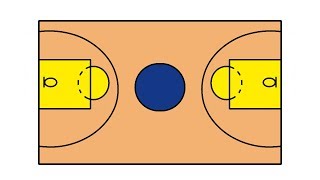
Begin by lightly sketching the outer boundary of the court. Use a horizontal rectangle as your starting point, leaving comfortable margins on all sides so nothing gets cut off. The width should be roughly half the length on your board, which gives you a realistic ratio without requiring precise scaling. Light construction lines allow you to adjust the proportions before committing to darker, permanent strokes. Once you are happy with the rectangle, darken the perimeter and label it mentally as the sideline and baseline framework.
Draw the Key Elements
Next, divide the court into its functional zones. Start with the free-throw lanes on each end, drawing them as rectangles extending from the baseline toward midcourt. These should be proportionally narrower than the full court width. Add the free-throw circles inside each lane, then draw the semi-circular restricted area just beneath the hoop. Move outward to sketch the three-point line, which arcs from the corner and sweeps around the key. In professional basketball, the corners are straight rather than curved, so make sure to note that distinction if you want your drawing to look authentic.
- The center circle: Draw a medium circle at midcourt with a diameter of about twelve feet in real life, keeping it scaled appropriately on your board.
- The hoops and backboards: Small rectangles near each baseline represent the backboards, with a dot or small circle below each indicating the rim location.
- The hash marks: Short perpendicular lines along the sidelines near the free-throw extensions add professional detail and signal familiarity with the actual court.
Use Color Strategically
Color is one of the most powerful tools available to you during a whiteboard interview. Reserve black for structural elements like lines, borders, and labels. Use red to highlight offensive movements, such as cuts, screens, or shooting paths. Blue works well for defensive positioning and player assignments. If you are diagramming a specific play, switch colors between offense and defense so the interviewer can follow the action without confusion. Erase any stray guidance lines once your final version looks clean, because a tidy diagram communicates professionalism more than a crowded one ever will.
Practice Under Time Pressure
Being able to draw a court accurately is one thing; doing it within a two-minute window is another. Set a timer and practice completing the full court multiple times until the process becomes automatic. Record yourself to identify where you spend too much time on unnecessary details. Rehearse explaining a play while drawing it, since many interviews combine both tasks. The goal is to build muscle memory so that when the interviewer says, “Show me what you mean,” your hand moves confidently without hesitation.
Deliver With Confidence
When the moment arrives, take a breath before you start. Stand to the side of the board so you are not blocking your own work. narrate your steps briefly if it feels natural, but avoid over-explaining simple lines. Point to key areas as you speak, making eye contact with the interviewers whenever possible. A well-drawn court on a whiteboard does exactly what words cannot—it turns abstract ideas into visual clarity, and in sports interviews, that visual proof of competence can be the difference between a good impression and a hired candidate.